Dale Carnegie How to Win Friends and Influence People Review
Book Review: How to Win Friends and Influence People
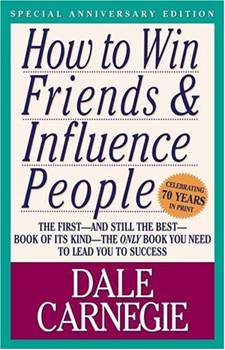
1 Sentence Summary of "How to win friends and influence people" : To make friends, influence others and get them in our corner, it is important to know how to look after their ego; this happens after an important alter in our everyday behavior, which consists of never criticizing, being genuinely interested in others, smiling, remembering the first name of the person we are speaking with, making them feel important, never telling them they are incorrect, talking about our own mistakes before talking near theirs, motivating, sincerely complimenting, and generally always looking after their cocky esteem.
By Dale Canergie, 1936 (get-go edition), 1981 (most recently revised edition), 250 pages.
Summary and Book Review of How to win friends and influence people :
Afterward GTD, this book is the second all-time seller of my crazy personal MBA challenge and it is certainly one of the best known. It has sold over 45 million copies effectually the earth since information technology was first published — a pocket-sized printing run of five m copies — in 1936. The volume has undergone several revisions since the expiry of the author in 1955, primarily past his married woman and his daughter in order to update examples given by the author about famous personalities who were known in 1936 but forgotten since — without changing the heart of the volume itself.
The author starts out past entrusting us with 8 rules for getting the best out of the volume, which seem to me to exist highly relevant and applicative to whatever number of not-fiction books:
- Accept a bang-up desire for learning and applying the principles that drive communications and relationships betwixt human beings.
- Read every chapter twice earlier going on to the next i.
- Interrupt our readings oft to ask ourselves virtually our personal possibilities for applying every principle.
- Underline the of import ideas.
- Re-read the book every calendar month.
- Practice the principles whenever the opportunity presents itself.
- Transform the book into a fun game: enquire our friends to pay a penalization whenever they surprise us by breaking the rules.
- Monitor the progress that we brand each week. Inquire ourselves what mistakes we have made, what progress we have fabricated, what lessons nosotros take learned.
Part One: Three fundamental techniques for handling people
Chapter i: If you lot want to get together honey, don't boot over the beehive
In 1931, Francis "2 Guns" Crowley, a gangster and assassin who was known for having killed a police officer in common cold blood after he asked him for his driving license, was arrested in his girlfriend'south flat afterwards a siege in which 1 hundred police officers were mobilized! He was taken alive, only, assertive he was every bit good as dead, he had taken the time to write a letter. Was it a letter of repentance, a letter of remorse for the crimes he had committed? No, it said "Under my jacket beats a weary centre, but a good one that would not injure anyone."
He was condemned to the electrical chair. When he arrived at the execution sleeping accommodation, was he total of excuses, did he declare that he was experiencing remorse? No. He said "This is my penalisation for wanting to defend myself."
Al Capone, the well-nigh notorious gangster of all time, himself said: "I accept spent the best years of my life giving pleasure to people and amusing them, and what has been my reward? Insults and the life of a hunted man." Often, gangsters, criminals and wrongdoers justify their behavior with a whole lot of logical or fallacious reasoning.
If criminals every bit notorious as Francis Crowley or Al Capone consider themselves innocent, what do the people nosotros meet every day who are just like yous and me think of themselves?
This is a universal constabulary that is sometimes difficult to accept: 99 times out of 100, homo considers himself innocent, no matter how serious his law-breaking. Criticism is therefore useless because it puts the private on the defensive and forces him to justify himself, and information technology is unsafe because it damages their self esteem and causes bitterness. Criticism is like a carrier pigeon: the person we desire to arraign and correct will exercise anything to justify himself and will condemn us in return. Or, often, they exclaim: "I don't see how I could accept acted any differently!"
When you study the lives of those considered great leaders of men, like Abraham Lincoln — who Dale Carnegie studied in a very thorough mode, even wrote a biography, Lincoln the Unknown — you more often than not find that they handle criticism with extreme circumspection and do everything to preserve the cocky esteem of those they reproach.
Rather than condemn people, it is amend to try and empathise them, to discover the motive for their actions. This is much nicer and more productive than criticizing, and it makes us more tolerant, understanding, and good.
Master # 1: Don't criticize, don't condemn and don't mutter
Affiliate 2 : The big secret of dealing with people

There is but i way in the world to get someone to do something: you must excite in them the desire to practise it. Plain, it is always possible to use force, authority or bribery, but these methods take way more than disadvantages than advantages. It is just by giving you what you desire that I will manage to go you to do something.
So, what are our needs? In a list that somewhat resembles Maslow's bureaucracy of needs, Dale Carnegie lists the unlike needs that we claim with ceaseless insistence:
- Health and preservation of life
- Food
- Sleep
- Money and the ways to procure it
- Time to come survival
- Sexual satisfaction
- Our children's happiness
- A sense of being important
Very oft, virtually of these needs are met, but in that location is one that is rarely satisfied, because it is just equally deep, and merely a imperative equally hunger. It is what Freud referred to every bit "the desire to exist recognized," what William James talks about every bit "the deepest chief of human nature," and that is the thirst for appreciation, recognition, to be considered of import. This desire distinguishes human being from the animals, in which it does non be.
It is this desire for importance that has driven many men who were poor at birth, to realize a glorious destiny, similar Lincoln, Dickens or Rockefeller, it is this want that drives men to buy cars that are as well large for their needs or a house that is much to huge for them.
Tell me how you fulfill this need, and I volition tell you who you are. The way in which we fill this need is one of the traits that best characterizes our personality. Some people fulfill it past turning to crime, like the notorious French Bonnot Gang, others write cracking works of literature, or build commercial empires or aid others with all their might, until their dying breath. History is full of amusing details about famous people who endeavour to prove their importance, from George Washington, who demanded to be chosen the "Greatest President of the United States," to Victor Hugo who wanted to donate his name to the city of Paris.
Annotation: And y'all merely accept to stroll through the Père Lachaise cemetery and read the epitaphs to understand that this demand for importance accompanied many men fifty-fifty in death.
So, what is the best style to requite a person the importance they seek and so much? It is by complimenting them. It is not a matter here of flattery, fake or otherwise, which is dangerous and frequently ends upwards coming back to bite the sycophant. It is a matter of a new mental mental attitude, of a new fashion of life: finding the good qualities in others and sincerely complimenting them, making them aware of the admiration we have for them. Sincere praise is the dearest of human relations — everyone seeks it and deeply appreciates it.
Master # 2: Compliment sincerely and honestly
Chapter 3: He who tin do this this has the whole earth with him. He who cannot walks a lonely way
Why are we always talking nigh what we want? It's vain, childish and absurd. Plain, each of us is interested in what we want. We will exist interested in it for eternity. But nosotros will be the only ones thinking well-nigh it. Anybody else is merely similar us in this regard and worry only about what they think.
That'southward why the only fashion to influence your neighbor is to talk to him about what he wants and show him that he can get it.
This is the surreptitious of success: putting yourself in someone else's place and thinking almost things from both his signal of view and ours. Because activity is born out of our fundamental desires, and to influence others y'all must beginning excite in them an ardent want to act.
Principal # iii: Motivate often to do what you propose.
Part Two: Six ways to make people like yous
Affiliate four: Do this and y'all'll be welcome anywhere
Exercise you like dogs? If yous do, why? Does information technology past whatever take a chance have something to do with the fact dogs are completely loyal, love you spontaneously and sincerely, and make a big fuss over y'all when you come up home? Practise you similar it when they leap upwards on you wagging their tail, with their natural language hanging out, before the door is fully open up, losing themselves completely in welcoming you?
Nosotros all know people who try their whole lives to get people interested in them. Wasted effort! People are only interested in themselves. They recollect about themselves morning, noon and night. When you lot wait at a photo of a group that you are office of, who do you look at first?
If you want people to exist interested in you, you must first be interested in them. Whether we are a ragamuffin or a king, we like those who admire us.
Do you want people to like y'all? And then write down anniversaries on your agenda and send a card, welcome people with warmth and enthusiasm on the telephone, show your admiration and your sincere interest when opportunity presents itself. Publius Syrus said information technology over two thousand years ago:
We are interested in others when they are interested in us.
Every bit with all the advice in this book, this must be applied with total sincerity. This way y'all might even touch the the middle of the near powerful and unreachable person.
Principal # 4: Be genuinely interested in others
Chapter five : A elementary way to brand a proficient get-go impression
Deportment speak louder than words. A smile says: "I like you," "I am happy to see you," "Your presence makes me happy," etc. Evidently, it needs to be a sincere, broad and spontaneous smile that seduces and comforts, not a mechanical and false smile that irritates instead of pleasing.
The virtually striking example of the effect of a sincere smile is the smile of a kid :

Oftentimes it communicates to us and can change our grimmest mood in an instant, whenever nosotros smile dorsum.
A grin is then important that information technology is can also be heard in our voice. Your phone voice will change if y'all smile; try it and see :)
Try this: For i week, in one case an hour, smile your widest, sincerest grin possible, exist nice to others, appreciate their visitor, because we must be happy in the company of our peers if we want them to be happy in ours. If this is hard for yous, tell yourself that it is simply one week and you tin can stop after that if you don't like information technology ;)
Main # 5 : Have a grinning
Affiliate 6 : If you lot don't do this yous are headed for trouble
James Farley, a famous American politician, has succeeded in becoming a cornerstone of American politics, depended on for decades, even though he was born to a poor family unit of farmers, even though he lost his father at historic period 10 and had to start working at that historic period on a structure site, pushing wheelbarrows full sand and letting bricks dry in the sun. When Dale Carnegie asked him his surreptitious, he replied that he could remember the first name of over five thousand people, as well equally the details of each of their lives.
He was Roosevelt's electoral agent. He had a unproblematic and remarkable system: whenever he met a new person he researched their beginning and concluding name — with its exact spelling — and carefully engraved the details in his mind, so he was able to greet this person by his get-go name past cross-referencing them later — sometimes years later.
Jim Farley knew that everyone likes his own proper noun ameliorate than any other name on earth. If y'all can remember someone'south proper name, you pay its owner a subtle and appreciated compliment. Simply if you forget it, mispronounce information technology or misspell it, you might upset someone or greatly displease them. Men are proud of their name and endeavor to perpetuate it at all costs.
In general, if we forget names, it'south because we simply don't take the time to write them down, repeat them, and engrave them permanently in our minds. This takes work and requires a certain corporeality of time, but the reward is definitely worth the effort.
Principal # 6: Call up a person's name so that they are of import
Chapter seven : An easy way to go a practiced conversationalist
How exercise you succeed with the person you are talking with? How do yous convince him and reach a good agreement with him? It's no mystery: to win someone over, put him in a good mood, and get him in your corner, you must give him your full attention when he expresses himself. Nothing is more flattering.

To do this, you lot must know how to listen sincerely, and bear witness it.
This also works with unhappy people, including customers. Often, unhappy customers who complain are deeply hurt themselves considering someone has fabricated them feel i way or another that they are non important. If yous succeed in showing them that they are important in your optics, and then oft their complaint will go away by itself.
On the other mitt, if you desire to know what to do to get people to run from you, mock y'all behind you back, or despise you, it'southward piece of cake: don't listen to what other people say; simply talk almost yourself. If an idea comes to you when someone else is talking, don't look until they are finished. What practiced will information technology do anyway? In whatsoever case, what they are saying can't exist as interesting and vivid as what you are going to say. Become on, actually, cut them off mid-sentence.
But if you want your conversation to be appreciated, acquire how to listen: to be interesting, be interested. Enquire stimulating, agreeable questions, inquire them about their life, what they have done. Remember that the person yous are talking to is a hundred times more interested in his toothache than in the famine that was responsible for thousands of deaths in Mainland china.
Chief # 7: Larn to listen. Encourage others to talk about themselves
Affiliate 8 : How to get people to like y'all instantly
To find the way to man'south heart y'all must bring him what he prizes the most
To discover what interests someone, what he is passionate about, all you have to do is stop and mind with involvement while he explains to yous everything you lot want to know.
Principal # 8 : Talk to people about what they are interested in
Affiliate 9 : How to make people similar you instantly
There is a primordial law that we must respect in our relationships with others. If we find information technology, we will win friendship and happiness. If nosotros violate it, we volition give rise to numerous difficulties in our wake. Here it is: Make others feel important.
You respect those around you, y'all wish them to do justice to your claim, and you similar very much feeling important in your own circle. Yous hate excessive flattery, but adore sincere praise, you want to be respected, encouraged, complimented. Nosotros all aspire to that.
Principal nine : Make others feel important and exercise it sincerely
Office Three: Twelve ways to win people to your way of thinking
Chapter 10 : Y'all can't win an argument
In his youth, Dale Carnegie adored controversy.
He studied logic and statement in higher, never missed the opportunity to participate in contradictory debates, and even directed a dialectic course equally a outcome, and made the project nearly writing on a subject… Then, afterward having attended and participated in thousands of discussions, he analyzed them and drew ane decision: the best mode to carry on a controversy is to avoid information technology. Nine times out of 10, everyone leaves the fence existence even more certain that they are right.
Finer, nobody wins these battles! Because if you lose, y'all lose and if you win, you too lose because you have proven to your adversary that he is incorrect, y'all have made him feel inferior, you have hurt his self esteem and his pride. So,
A human convinced against his volition
Always keeps his ain stance.
You lot must therefore cull: a spectacular and theoretic triumphant, or sincere agreement. The two rarely go together. You may well be right, a hundred times right, if you accept to fight prove it and change your adversaries listen, your efforts volition equally useless every bit if you were wrong.
But what should you practise then if there is disagreement? The idea is to welcome the dispute. The dispute is an opportunity to enrich yourself, to discover a new point of view that had non occurred to yous before. Hither is advice in such a situation:
- Don't give in to your first impulse.
- Overcome your anger.
- Brainstorm by listening.
- Find common ground.
- Be honest.
- Promise to think about the ideas of your adversaries, and written report them carefully.
- Sincerely thank your adversaries for their interest.
- Adjourn your actions to allow both parties present the time to examine the problem in detail.
Main # x: Avoid controversy, unless you tin can come out on peak.
Chapter xi: A sure fashion of making enemies and how to avoid it.
When Theodore Roosevelt was the President of the United States, he admitted that he couldn't be sure he was right more than 75% of the time. That was the outer limit of his potential. If that is the caste that such a successful homo could attain, and then what is it for you and me?
Really, if we could exist sure of being right even 50% of the time, all that would exist left to do would be to install ourselves on Wall Street and earn a million dollars a day. Just if we tin can't achieve this percentage, why do nosotros let ourselves to country that others are wrong?
So don't always begin a sentence with "I will prove that to yous" or "I can evidence that…" because that comes out every bit "I am smarter than you lot, and I am going to alter your listen," that can only hurt someone's self esteem without irresolute their mind. It is actually difficult, fifty-fifty under favorable conditions, to modify other people's opinion, so why nowadays obstacles and add together even more difficulty?
If someone states something that you think is wrong, wouldn't it be amend to start with: Listen, I don't come across it the same way every bit you but I might be incorrect. That happens to me a lot. If I am incorrect, I will change my mind… Allow's have a look together, would you mind?
This type of phrasing is magic considering no-one can object to "I might be wrong, allow's accept a look together." Who can detect anything to say nearly that? Therefore no-one volition e'er be annoyed with you lot if you promptly admit that you are field of study to error.
Here is an excerpt from the book "The Mind in the Making" by James Harvey Robinson to learn more:
[Translator'southward notation: The book excerpt is translated from the French version, so the text may not match the English language version of the volume exactly]
We tin can spontaneously modify our opinions effortlessly and without emotion. But if someone tells u.s.a. that we are wrong, nosotros revolt against the accusation and instantly adopt a defensive attitude. We form our convictions lightly, but the instant anyone threatens to snatch them from usa, we develop a violent passion for them. Obviously, it is non then much our ideas as it is our self esteem that we fear is in danger…
Main #11: Respect others' opinions. Never tell people they are incorrect.
Affiliate 12: If you're wrong, admit it.

1 day, the author was walking his domestic dog off the leash in a park, which was not immune. He came face to face with a mounted policeman who, after a sharp reprimand, told him never to come up back. A week subsequently, Dale Carnegie came across the aforementioned policeman, in the verbal same circumstances. What did he do? He rushed upwardly to the policeman and overwhelmed him with apologies, and reminded him that he had promised to fine him if he did it again. The policeman's respond was mellow, Dale Carnegie insisted that he was at fault, and finally the policeman allow him off the hook.
Because the policeman, like all of united states of america, was only a man; what he wanted was confirmation of his own importance. When Dale Carnegie confessed, the only thing left for the policeman to practice to maintain his own self esteem was to prefer a magnanimous attitude.
When we know that we deserve a dressing downwards, isn't it meliorate to have the initiative bravely and brand our mea culpa? If we inflict arraign on ourselves, isn't it more than acceptable that way than from someone else's mouth?
Master #12: If you are wrong, admit it promptly and energetically.
Chapter 13: A drop of honey
Aesop, a greek slave from the seventh century BC, has explained the point of this chapter once before:
One day, the wind and the sun were arguing over who was the strongest. The wind said:
- I am going to prove that I am. You see that onetime man down there? I bet that I tin can brand him have his coat off faster than you can.
Upon which the sun disappeared behind a cloud and the air current started to accident similar a hurricane. Just the harder it blew, the more the man cinched his coat around him. Finally, the wind became tired and stopped blowing. Then, the sun came out from behind a cloud and smiled gently to the traveler. Shortly he started to feel warm; he wiped his forehead and took off his coat.
The lord's day then remarked to the air current that sweetness and kindness are e'er stronger than violence and fury.
Principal #13: Brainstorm on a friendly annotation.
Chapter 14: The Secret of Socrates
When you want to win someone over, avoid raising issues that you don't agree with, from the very start. Focus instead on things yous place with and emphasize those. The indicate is to evidence that you have goals in mutual, and disagree only on the means to achieve them, and to practice that, say "aye" as early as possible, and above all try to avoid having them say "no."
Because as Dr Overstreet says in his book "The Art of influencing the human condition:"
A negative response is a hard obstacle to overcome. When someone says "no," his pride causes him to remain steadfast in his opinion[…]. After, he may figure out that it was an unjustified no. Too bad! He cannot retract it; he must above all look out for his self esteem. That'due south why it is extremely important to showtime out, from the beginning, with the person you are talking to in the right management: that of agreement.
[…]
When someone says "no" sincerely and with confidence, they can practice no more than articulate those two letters. […] Their whole being is on the defensive, the whole neuro-muscular system is alerted against agreeing.
On the other mitt, when someone says "aye," their body takes on a consenting, receptive attitude. Consequently, the more nosotros can go people to say aye, the more we succeed in putting someone in a favorable mood towards our proposition.
Principal #14: Ask questions that will lead to maxim yes immediately.
Chapter 15: The safety valve in handling complaints
Nearly people say too much when they are trying to persuade someone. Let the other person vent. He knows his bug and his business better than you. Ask him questions and permit him express himself. This produces good results in professional person relationships also as between friends and family.
Main # 15 : Make the person you are talking to feel completely comfortable speaking.
Chapter sixteen: How to get cooperation
Don't we trust the ideas that we recall of by ourselves more than than those are handed to us prepare to proceed a silverish platter? If that's truthful, isn't it clumsy to try and impose our opinions at all costs? Isn't it wiser to brand some clever suggestions and leave the other person to describe his own conclusions?
Twenty v centuries ago, Lao-Tsu, a wise homo from People's republic of china said that the reason why rivers and seas are graced with certain mountain streams is because they go along a low profile. They can thus reign over all the mountain streams. The wise man, who wants to exist above others, puts himself below them; if he wants to be in front end, sets himself backside. Thus, if his place is to a higher place others, they don't experience his weight; if his place is in front, they are not hurt.
Chief #16: Allow the person you are talking to the pleasure of thinking it was his idea.
Affiliate 17: A formula that will piece of work wonders for you.
Even if your neighbor is wrong, he doesn't remember he's incorrect. Don't condemn him. The showtime fool that comes along can condemn him. Rather, try to empathize him. Those who would be wise are tolerant and fifty-fifty exceptional.
Actually, your neighbor has a reason for thinking and acting as he does. Find out the hidden reason and you will sympathize the secret to his behavior, and probably to his personality.
Recall about the deviation that exists between the passionate interest that you accept for your own business and the luke warm attention that you pay to the rest of the word. Ponder, and ponder deeply on the fact that everyone in the earth experiences the same thing as yous. If you tin sympathize that, and so you can considerably perfect the art of leading men.
Principal #17: Make a real try to encounter things from the other person's point of view.
Chapter 18: What everybody wants
Wouldn't yous like to know a magic phrase that lets you avoid arguments, dissipates bitterness, stimulates good volition and motivates others to listen to you lot advisedly?
Yes? Well so, information technology does exist. Here is it:
"I understand completely where y'all are coming from, if I was you I would probably feel the same."
Endeavour information technology and you will encounter ;)
Principal #18: Welcome kindly the ideas and desires of others.
Chapter 19: Appeal that everybody likes
Anybody we encounter has a loftier opinion of himself and wants to appear noble and generous in their ain eyes. Therefore, individuals generally accept two reasons for their behavior: one which makes him look good, and the existent one. An individual understands the second one very well, but he prefers to put his well-nigh worthy reasons out in forepart.
Then, to influence others it is amend to appeal to their about noble intentions. For fear of shattering the idealist paradigm they have of themselves, they will be more motivated to reply to your pleas.
Note : The desire to show just the nigh noble motivation is not merely potent to protect their self image, but too the epitome they wish to project to others.
Principal #19: Entreatment to higher feelings.
Affiliate 20: The movies do information technology. TV does it. Why don't you do it?
At the commencement of the last century, a newspaper was the object of vicious rumors that finer said that the paper had too many advertisements and not enough text; that it was no longer interesting to its readers, etc. They needed to deed fast to halt the devastating rumors. Just how? The staff of the newspaper had a practiced idea: they would cut all the text that wasn't advertising from one edition, and publish it in the form of a book, they would call it "One Day." The book, which was 307 pages long, would go for average price, considering the paper was sold at only a fraction of the usual price of a volume.
The publication highlighted the lies and rumors, and appealed to people in a more disarming and more attractive way than a whole pile of figures and arguments.
Principal #20: Show off your ideas spectacularly. Appeal to both sight and imagination.
Chapter 21: When zippo else works endeavour this
The need to excel and compete are ii extremely powerful drivers for the human spirit. To go results, create competition, not for the sake of winning, merely to lubricate in a noble way the desire to do ane's best, to outdo others and to excel.
Master #21: Nowadays a challenge.
Function Four — Exist a leader: how to change people without living offensively or arousing resentment
Chapter 22: If you lot must find fault, this is the way to begin
Information technology involves an obvious process, but it gets results; it less painful for u.s.a. to receive unpleasant comments later on a compliment about our ability.
Master #22: Start out with sincere praise.
Chapter 23: How to criticize and not exist hated for it
One solar day, a senior person in a steel factory was walking the floors. He ran across a grouping of workers smoking. But above their heads was a sign on which was written "no smoking." What practice you think the person did? Did he mouth off at these people yelling "Don't you know how to read?" No. He approached them, offered each of them a cigar and said "I would similar it if you lot went to fume these cigars outside."
How practise you recollect the workers felt? They were in violation and they knew he knew it. Instead of punishing them, he offered them a gift and didn't say a affair to reproach them. He had fabricated them feel important. Who couldn't like a human being like that?
With reasonable people who would suffer under directly criticism, draw attending to their mistakes indirectly, and yous volition work wonders.
Principal #23: Comment on mistakes or errors indirectly.
Chapter 24: Talk about your own mistakes offset
By acknowledging our own mistakes, even if we have non corrected them, we can help others to modify their behavior. A few humble words can greatly help to deliver the biting pill of criticism .
Master #24: Mention your own mistakes earlier correcting those of other people.
Chapter 25: Nobody likes to take orders
An order which is too brusque tin can cause someone long lasting offense, even if the gild is justified. Instead, ask questions such as "Could you take a look at this?" or "Practise yous call up this would be okay?" or "Would you do this?" Asking questions doesn't just make orders more palatable, it besides stimulates the other person's creativity. People accept orders more readily if they have been part of the initial decision.
Principal #25: Ask questions rather than giving direct orders.
Chapter 26: Let the other person salvage face up
Here is how Saint Exupéry put it:
I don't have the right to say or exercise something that diminishes a homo in his own eyes. What counts is non what I call up of him, simply what he thinks of himself. Hurting a man's dignity is a law-breaking.
Principal #26: Permit the person you lot are speaking with save face.
Chapter 27: How to spur people on to success
Psychologist Jess Lair wrote the following:
Praise is like sunshine for the human spirit. We cannot flourish without it. Nevertheless, almost of use are prepare to accident the cold wind of criticism on others, rather than warm their heart with a compliment.
So, permit's admit the progress, however slight it is, of those we wish to encourage. That'south how we will motivate them, how we will get them to pursue their efforts.
Principal #27: Praise the smallest progress and praise whatever progress. Do it warmly and generously.
Chapter 28: Give a dog a expert proper noun
For this, there is nothing better than complimenting someone on their potential or their past coups, and asking them if they think they will get back to that initial level or achieve their full potential.
Main #28: Give a practiced reputation to the deserving.
Chapter 29: Making the fault seem easy to correct
Tell your colleague, your kid or your coworker that they are stupid, that they are not cut out for such work, or such a game, that they are doing badly, that they don't understand anything, etc, and you will destroy any desire they have to excel. Simply effort it the reverse way: Give generous encouragement; make it so the task to exist achieved appears piece of cake, let them know you are backside them, that you accept confidence in their abilities, tell them they have untapped talent… and they will use it all mean solar day long if necessary.
Chief #29: Encourage. Make errors seem easy to fix.
Chapter xxx: Making people glad to practise what y'all want
To change someone'southward attitude or behavior, information technology is useful to keep the following points in mind:
- Be sincere. Don't make simulated promises. Forget your ain interests and focus on the involvement of the other person.
- Make certain you know exactly what you want the person to exercise.
- Put yourself in the other person'southward place.
- Think well-nigh the benefits that the other person will get out of doing what you want them to do.
- Brand sure these benefits line up with what the other person wants.
- When you make an offering, construction it in such a manner that the other person understands that he will benefit personally.
Principal #30: Make others happy to exercise what y'all suggest.
Book Critique of How to Win Friends and Influence People :
I am pleased that I read this book. It has been on my listing of books to read for years (which has go significantly larger since my Readers have been sending me suggestions!) and I finally institute the opportunity to option it upward. Equally to the format, this volume is written in a simple, accessible way.
Dale Carnegie seems to write as he Speaks, staying very concrete, concise and relevant, and using many examples from existent life — what am I proverb? — a plethora of examples — of which you have only a pocket-sized sample in this summary.
These examples might seem dated — they engagement from the Ceremonious War to the 2d Globe War for the almost part — only they are extremely varied, from a president, a male monarch and an emperor, all the style to factory directors, finance magnates or workers. They permit us to get into the concepts very easily and sympathise how to use them on a daily basis.
Regarding content, I found this volume extremely interesting, because of the primordial importance it accords to the ego and self esteem. Dale Carnegie puts the deeply emotional nature of human beings first, and the whole book is centered on these ii primordial concepts:
ane. No affair what they say, men and women are above all emotional beings with a vital demand to wait kindly on themselves.
2. No matter how rational an argument might exist, they volition reject it most of the time if their cocky esteem is hurt.
Once you empathize these two concepts, about of the principles of the book are simple to understand. All you lot have to do is apply them. The eight pieces of advice that Carnegie gives at the beginning of this book — and that could easily exist applied to nearly all the Personal MBA books — are, I think, a good beginning for implementing.
Equally with everything, this advice must be practical in moderation, otherwise I think we could become machines generating consensus, which would exist a bit bland and hypocritical. I also think that a skillful Kick in the rear tin produce better results than all the diplomacy in the world.
But Carnegie'southward approach doesn't consist of adopting mechanical tricks to artificially increase his influence, it consists of agreement the 2 concepts presented above, and internalizing them to transform our point of view with regard to human being relationships and remaining watchful so that the other person comes out on top, or at to the lowest degree free, in our arguments, confrontations and other issues.
It'due south a huge program. I am sure that human relationships would be a bit smoother if everyone applied the principles in this book.
What's more than, it's an excellent introduction to the ideas of ego and self esteem, and a betoken of departure for me with sure questions: why is it and so important to us to maintain the vision of ourselves intact, and the way that we think of ourselves even though very often we "form our opinions lightly?" Why do we favor a comfy vision even though it is imitation, to the truth? What is ego? Cocky esteem? Are they deeply human and therefore universal, greatly influenced by society or not? In short, great, interesting questions but which require sometime to be understood.
I therefore recommend this book. Information technology'due south first-class, may change the way in which nosotros look at human relationships and is easy to read. A must have.
Strong points:
- Clear and concise
- Written merely and is piece of cake to read
- Numerous examples covering a wide variety of situations
- Potent, relevant, fundamental concepts
- Many principles that can exist applied or internalized
Weak Points:
- The examples are a petty dated (from the Civil War to the Second World War primarily)
- A little redundant at times
Source: https://olivierrolanden.medium.com/book-review-how-to-win-friends-and-influence-people-80a34b3730f8
0 Response to "Dale Carnegie How to Win Friends and Influence People Review"
Post a Comment